Read paper
Inhoudsopgave:
- Inleiding
- Hoe werkt photobiomodulation
- Toepassingen
- Systemische effecten
- Golflengten en penetratiediepte
- Pulsing
- Dosering
- Het bifasische effect
- Bijwerkingen en risico’s
- Contra-indicaties
- Research
- Uitgelicht: PBM in de neurologie
- Consumentenmarkt en PBM op voorschrift
- Wellnessbehandelingen en alternatieve zorg
- Kosten
- Beschouwing
- Conclusies en aanbevelingen
- Over de auteur
- Disclaimer
- Bronnen
1. Inleiding
Photobiomodulation1 – in het vervolg afgekort als PBM – is een therapievorm waarbij rood en nabij-infrarood licht wordt gebruikt om biologische processen te beïnvloeden. De lichttoediening gebeurt met behulp van lasers of led-lichtbronnen.2
Andere namen die voor PBM worden gebruikt zijn:
- Low level laser therapy (LLLT)
- Photomedicine
- Roodlichttherapie / Red light therapy
PBM is in 1967 ontdekt door de Hongaarse arts en onderzoeker Endre Mester toen hij onderzoek deed naar de effecten van laserlicht op kanker in muismodellen.3 Hij ontdekte toen per ongeluk dat laagvermogen laserlicht de haargroei en wondgenezing stimuleerde in de behandelde huid.
Omdat lasers destijds erg duur waren, de effecten op moleculair niveau onverklaarbaar waren, en de wetenschappelijke gemeenschap sceptisch was, bleef PBM lange tijd onbekend en werd maar beperkt toegepast. Pas sinds de opkomst van goedkopere, veilige apparaten en meer systematisch onderzoek begint PBM meer bekendheid te krijgen.
Door de komst van led-technologie en de veel lagere kosten van deze apparaten heeft de consumentenmarkt inmiddels een grote voorsprong op de medische praktijk. Consumenten hebben toegang tot een therapievorm die toegepast kan worden bij serieuze medische aandoeningen zoals bijvoorbeeld dementie en de ziekte van Parkinson, waar hun artsen vaak niet of onvoldoende van op de hoogte zijn. Consumenten kunnen de apparatuur kopen via webshops, en voor informatie, wetenschappelijk onderzoek en behandelprotocollen terecht op verschillende websites, YouTube, TikTok en Facebook. Hoewel de meeste informatie in het Engels beschikbaar is, groeit ook het aantal Nederlandse webshops, websites en blogs.
In de medische praktijk ligt dit ingewikkelder. Een arts kan niet zonder meer een behandeling toepassen zonder voldoende bewijs en richtlijnen. De vraag die rijst is dan ook of en wanneer de medische praktijk aan kan sluiten, of dat patiënten in toenemende mate het heft in eigen handen zullen nemen om zelf hun aandoeningen te behandelen, en of dit laatste wenselijk is.
Dit document is bedoeld om medici basisinformatie te geven en hen de vraag voor te leggen of PBM een professionele zorginnovatie of enkel een vorm van zelfbehandeling zou moeten zijn.
2. Hoe werkt photobiomodulation?
Photobiomodulation wordt in de literatuur doorgaans beschreven als een proces waarbij lichtenergie van rood en nabij-infrarood licht door cellen wordt geabsorbeerd, wat leidt tot verschillende biologische effecten. De golflengten die bij PBM worden toegepast maken deel uit van het natuurlijke zonlichtspectrum, maar worden afzonderlijk en gericht toegediend.
Hoewel er nog onderzoek plaatsvindt naar de precieze werkingsmechanismen van PBM, zijn er verschillende effecten die in de wetenschappelijke literatuur consistent worden beschreven. Een van de meest consistent beschreven bevindingen is dat rood en nabij-infrarood licht de energieproductie door de mitochondriën stimuleert.
In de mitochondriën, de energiecentrales van de cel, wordt het licht geabsorbeerd door cytochroom c-oxidase, een enzym in de elektronentransportketen. Dit leidt tot het tijdelijk losmaken van stikstofmonoxide (NO), waardoor zuurstof weer efficiënt kan binden en de cellulaire ademhaling verbetert. Het resultaat is een hogere productie van adenosinetrifosfaat (ATP), de energievaluta van de cel, waardoor cellen meer energie beschikbaar hebben voor hun taken en herstel.4
Een ander veel beschreven effect is dat het vrijkomen van stikstofmonoxide kan bijdragen aan vaatverwijding, wat de doorbloeding van het weefsel kan ondersteunen en op die manier herstelprocessen bevordert.4
Bij dit proces ontstaan ook lage concentraties Reactive Oxygen Species (ROS), reactieve zuurstofcomponenten, die vaak ook ‘vrije radicalen’ worden genoemd. In deze lage concentraties fungeren ROS als signaalmoleculen die cel communicatie en intracellulaire signaalroutes activeren. Samen met veranderingen in ionenstromen, zoals calcium, kunnen zij genexpressie, eiwitsynthese en de productie van groeifactoren stimuleren. Hierdoor kan belichting van weefsel een cascade van biologische reacties op gang brengen die functie en herstel van het weefsel ondersteunen.5
Waarschijnlijk verschillen de exacte biologische effecten per golflengte van het licht, maar voor deze publicatie gaat het te ver om alle bekende of veronderstelde cellulaire en moleculaire mechanismen van PBM te beschrijven. Voor meer informatie verwijs ik naar het overzichtsartikel ‘Photobiomodulation: shining a light on depression’ van Wang L. et al.[ii] waarin deze processen in detail worden besproken. Ook het boek ‘The Ultimate Guide to Red Light Therapy’ van Ari Whitten (2025) is een goed startpunt.
3. Toepassingen
PBM kent grofweg vier toepassingen:
- Cosmetisch
- Sportprestaties en herstel
- Medisch
- Endocrinology
Cosmetisch:
PBM kan worden gebruikt om effecten van veroudering, zoals fijne lijntjes en rimpels, tegen te gaan, door stimulatie van de collageen- en elastineproductie. Daarnaast kan PBM worden ingezet bij acne en haaruitval.6 Voor deze toepassingen worden op de consumentenmarkt diverse apparaten verkocht die led-technologie gebruiken, zoals gezichtsmaskers, draagbare (‘handheld’) apparaten of kleine panelen.
Sportprestaties en herstel:
In de sport wordt PBM gebruikt voor betere prestaties, uithoudingsvermogen en herstel.7 Hiervoor worden meestal de grotere ‘full body’ -panelen met led-technologie gebruikt.
PBM wordt ook gebruikt voor sneller herstel van sportblessures, zoals spier- en peesklachten. Voor deze toepassing worden meestal kleinere led-panelen of draagbare apparaten gebruikt voor meer gerichte lokale behandeling.
Medisch:
Op medisch gebied kan PBM oppervlakkig worden toegepast, bijvoorbeeld ter ondersteuning van wondgenezing, maar ook op dieperliggende weefsels. PBM is daarnaast onderzocht bij een brede reeks aandoeningen bij vrijwel alle specialismen, waaronder diabetes, dementie, depressie, de ziekte van Parkinson, multiple sclerose (MS), chronische pijn en artrose.8
Bij deze onderzoeken wordt meestal gebruik gemaakt van lasers, maar in toenemende mate ook van led-technologie.
Diergeneeskunde:
In de veterinaire zorg wordt PBM met lasers en led-technologie toegepast voor pijnverlichting, herstelbevordering en de algehele kwaliteit van leven van huisdieren en paarden. Er zijn voor paarden bijvoorbeeld speciale pads voor de benen en hoeven.9
4. Systemische effecten
Uit onderzoek is gebleken dat PBM niet alleen lokaal werkt. Er zijn aanwijzingen dat het ook systemische effecten heeft. Zo blijkt uit een studie met konijnen uit 2014 dat wanneer ze de rechterpoot belichtten, de linkerpoot ook sneller genas nadat ze in beide poten een schroef geïmplanteerd hadden gekregen.10 Dit effect wordt het abscopale effect genoemd. Ook zijn effecten van ‘remote PBM’ gezien bij ratten met geïnduceerd parkinsonisme die op de rug werden behandeld en de kop werd afgeschermd met aluminiumfolie.11
Ook bij mensen zijn systemische effecten waargenomen. In een studie uit 2024 met een orale glucose-tolerantietest bij gezonde proefpersonen bleek bijvoorbeeld dat 15 minuten PBM (670 nm, 40 mW/cm2) op de rug (800 cm2) voorafgaand aan de test de stijging van de bloedglucose significant verminderde. Dit suggereert dat PBM invloed kan hebben op het metabolisme buiten het direct belichte gebied.12
Daarnaast is in verschillende studies gebleken dat PBM, toegepast voor andere indicaties zoals lage rugpijn13,14 , ook een positief effect kan hebben op depressieve klachten.
De systemische effecten ontstaan vermoedelijk doordat PBM circulerende factoren, groeifactoren en immuuncellen activeert, die signalen door het hele lichaam doorgeven en zo herstel en functionele aanpassing in niet-behandelde weefsels stimuleren. Dit wordt verder onderzocht door PBM intraveneus toe te passen, waarbij het licht via optische vezels in het bloed wordt toegediend15 (‘intravasculair laser irradiation of blood’ afgekort als ILIB).
Een gebied dat in dit kader bijzondere aandacht verdient is het buikgebied. Uit dier- en kleinschalige humane studies blijkt dat PBM op de buik de darm‑hersen‑as kan beïnvloeden, de communicatie tussen darmen en hersenen, via samenwerkende mitochondriale, immuun- en microbiële mechanismen.16 Een klinische studie bij mensen met de ziekte van Parkinson rapporteerde dat een 12‑weekse PBM‑behandeling van buik, hoofd en nek leidde tot veranderingen in de samenstelling van het darmmicrobioom, waaronder een verschuiving in de verhouding tussen de belangrijkste bacteriegroepen (de Firmicutes:Bacteroidetes‑ratio), die vaak wordt gezien als marker voor darmgezondheid.17 De oorspronkelijke studie naar de effecten van PBM lieten significante effecten zien ten aanzien van mobiliteit, cognitie, dynamische balans en fijne motoriek.18
5. Golflengten en penetratiediepte
Bij PBM wordt gebruikgemaakt van lasers en led-technologie.19 Het verschil tussen beide ligt niet in de golflengte, maar vooral in coherentie, bundeldichtheid en vermogen.
Laserlicht is coherent en bundelt de energie in een smalle straal, waardoor hogere vermogensdichtheden mogelijk zijn en het licht soms iets dieper kan doordringen. Het vermogen van therapeutische lasers ligt doorgaans tussen 1 en 500 mW/cm², afhankelijk van de toepassing en het apparaat.
Led-licht is incoherent en verspreidt zich meer. Het heeft lagere vermogensdichtheden, vaak tussen 1 en 100 mW/cm², wat veiliger is voor toepassing door consumenten.
Beide typen lichtbronnen kunnen effectief zijn, afhankelijk van de gewenste penetratiediepte en de grootte van het te behandelen gebied.20
De gebruikte golflengten liggen globaal tussen 600 nm en 1100 nm. In zowel wetenschappelijk onderzoek als in commerciële PBM-apparatuur worden vooral de volgende golflengten toegepast:
- Rood licht: 630, 660 en 670 nm. Deze worden vooral gebruikt voor oppervlakkige toepassingen zoals huidverbetering, stimulatie van collageenproductie, wondgenezing en oppervlakkige pijnvermindering.21
- Nabij-infrarood licht (NIR): 810 nm, 830 nm en 850 nm. Deze worden meestal toegepast voor diepere toepassingen zoals spieren, pezen, zenuwen en de hersenen.20
- Hogere NIR-golflengten: 904 nm, 1064 nm, 1072 nm en 1090 nm. Deze worden eveneens ingezet bij diepere weefsels, zoals spieren, zenuwen en de hersenen.
Soms wordt ook blauw licht toegepast, met golflengten tussen 405 en 470 nm.22 Dit dringt nauwelijks door in de huid, maar kan vanwege antibacteriële en ontstekingsremmende effecten worden gebruikt bij huidaandoeningen als acne.
Rood licht en nabij-infrarood licht is niet hetzelfde als het licht dat in infraroodsauna’s wordt gebruikt. Bij sauna’s wordt gebruik gemaakt van Ver-infrarood licht (FIR) met golflengtes tussen 6000 en 14.000 nm. De effecten hiervan, zoals een verbeterde doorbloeding, berusten voornamelijk op het thermische (warmte)effect.23
De daadwerkelijke penetratiediepte van rood licht en nabij-infrarood licht hangt af van verschillende factoren zoals golflengte, vermogen, afstand tot de huid en het type weefsel. In schema’s die vaak in de literatuur worden weergegeven, wordt doorgaans aangegeven dat rood licht ongeveer 4 tot 5 mm onder het huidoppervlak kan doordringen en nabij-infrarood licht ongeveer 5 tot 6 mm.24 Andere bronnen suggereren echter dat het licht tot meerdere centimeters kan doordringen in spieren en andere weefsels.5 In de praktijk is bovendien waarneembaar dat rood licht door een (kleine) hand of de wang heen zichtbaar kan zijn. Er is dan ook nog discussie over de precieze penetratiedieptes.
Over de doorlaatbaarheid van de schedel bestaat eveneens onduidelijkheid. Het is wel duidelijk dat zowel rood licht als nabij-infrarood licht de schedel kan passeren, maar dat een grootst deel van de energie daarbij verloren gaat voordat het onderliggende weefsel wordt bereikt. Dit is mede afhankelijk van de toedieningsplaats en de individuele variatie in de dikte van het schedelbot. Nabij-infrarood licht lijkt hierbij beter door bot te dringen dan rood licht, al wordt ook rood licht toegepast bij onderzoek naar de behandeling van de hersenen.25
6. Pulsing
Sommige lasers en led-apparaten leveren niet alleen continu licht, maar hebben ook één of meerdere standen waarbij het licht zeer snel aan en uit gaat met een bepaalde frequentie, wat ‘pulsing’ wordt genoemd.
Volgens een reviewstudie uit 2010 zijn er aanwijzingen dat gepulst licht andere biologische effecten kan hebben dan continu licht, waarbij ook de frequentie en andere parameters van invloed zijn op de uitkomsten.26 Sindsdien zijn er meerdere studies verschenen waarin gepulst en continu licht met elkaar zijn vergeleken, maar de resultaten daarvan zijn wisselend.
Door het ontbreken van een recente systematische review blijft het vooralsnog onduidelijk of gepulst licht effectiever is dan continu licht.
7. Dosering
Buiten het vermogen en de golflengte is ook de dosering van het licht van belang bij een behandeling met PBM. De dosering (J/cm2) wordt berekend door het vermogen van het apparaat (mW/cm²) te vermenigvuldigen met de belichtingstijd (seconden) en het resultaat door 1000 te delen.27 Dit getal geeft aan hoeveel lichtenergie daadwerkelijk op het behandelde weefsel wordt overgedragen en is dus belangrijk om het beoogde therapeutisch effect te bereiken, zonder schade of onvoldoende stimulatie.
Energie (J/cm2) = Vermogen (mW/cm2) x Tijd (s) / 1000
Zie ook de online calculator.
De afstand tussen het apparaat en de huid speelt hierbij een belangrijke rol. Het vermogen dat op het weefsel aankomt neemt af naarmate het apparaat verder van de huid wordt gehouden. Hoe snel het vermogen afneemt hangt af van de specificaties van het apparaat, zoals de lichtbron en stralingshoek. Het verschil kan aanzienlijk zijn tussen direct contact met de huid en enkele centimeters afstand.28 Bij het bepalen van de juiste dosering moet daarom altijd rekening worden gehouden met de aanbevelingen en specificaties van het gebruikte apparaat.
Hierbij moet worden opgemerkt dat deze berekening alleen de energie per cm2 weergeeft en geen rekening houdt met de totale omvang van het belichte oppervlak. Bij behandeling van grotere oppervlakken kan de totale toegediende energie daardoor aanzienlijk hoger zijn dan de waarde in J/cm² doet vermoeden. In de eerder aangehaalde studie met een orale glucose-tolerantietest (hoofdstuk 4) werd bijvoorbeeld een gebied van 800 cm² belicht. De energie bedroeg hierbij 36 J/cm², wat overeenkwam met een totale toegediende energie van 28.800 J.
Dit aspect is met name relevant bij de toepassing van grote led-panelen die op de consumentenmarkt beschikbaar zijn en waarmee in één behandeling grote delen van het lichaam kunnen worden belicht. Hoewel deze apparaten vaak worden beoordeeld op basis van de dosering per cm², kan de totale hoeveelheid toegediende energie bij gebruik op grote oppervlakken aanzienlijk toenemen.
Omdat uit onderzoek blijkt dat PBM niet uitsluitend lokaal werkt, maar ook systemische effecten kan hebben, is het de vraag of enkel de energie per cm2 voldoende is om de (mate van) biologische respons volledig te beschrijven. De invloed van de grootte van het behandelde oppervlak verdient daarom verdere aandacht in toekomstig onderzoek.
8. Het bifasische effect
Bij PBM moet rekening gehouden worden met het fenomeen dat bekendstaat als het ‘biphasic effect’. Dit houdt in dat de biologische effecten van het licht niet lineair toenemen met de dosis.
Bij te lage doses werkt PBM niet, bij hogere doses kan PBM cellen stimuleren, maar bij te hoge doses kan het effect juist afnemen of zelfs contraproductief worden.29 Overmatige belichting kan leiden tot oxidatieve stress door te veel ROS, waardoor cellen juist minder efficiënt functioneren en herstelprocessen vertraagd worden.
Bij consumentenproducten wordt om deze reden vaak een maximale belichtingstijd van 20 minuten aangehouden.30,31 In de praktijk lijkt het biphasic effect bij deze apparaten echter mee te vallen. Er zijn anekdotische meldingen van mensen die tijdens het gebruik in slaap vallen en na een uur pijnvrij wakker worden.18 Het zou ook per golflengte, weefseltype en andere factoren kunnen variëren wanneer dit effect optreedt. Meer onderzoek is dus nodig om dit effect beter te beoordelen.
9. Bijwerkingen en risico's
PBM wordt in de wetenschappelijke literatuur over het algemeen beschreven als een veilige en goed verdraagbare behandeling wanneer deze binnen gangbare therapeutische parameters wordt toegepast.32,33,34 Als er bijwerkingen optreden, zijn deze meestal mild en tijdelijk, en verdwijnen spontaan na het stoppen van de behandeling. Gemelde reacties zijn onder andere tijdelijke huidirritatie of huiduitslag, vermoeidheid en lichte hoofdpijn.35
Consumentenpanelen met een hoog vermogen lijken door gezonde personen over het algemeen goed te worden verdragen. In gebruikersgroepen op Facebook zijn echter meldingen te vinden van mensen met complexe aandoeningen die aangeven het gebruik te moeten beperken vanwege vermoeidheid of andere niet altijd nader gespecificeerde klachten. Gezien het beperkte onderzoek naar PBM bij specifieke patiëntengroepen en de brede biologische effecten van PBM, lijkt voorzichtigheid – zoals het starten met een lage dosering – en passende medische begeleiding bij mensen met bepaalde aandoeningen, zoals ME/cvs of Long COVID, wenselijk.
Hoewel lichttherapie met succes therapeutisch wordt toegepast in de oogheelkunde36 is voorzichtigheid geboden. Het is algemeen bekend dat blootstelling van de ogen aan krachtige lichtbronnen moet worden vermeden. Laserlicht geeft het grootste risico op netvliesschade door de sterke bundeling van het licht. Led-licht is minder geconcentreerd en daardoor minder risicovol dan laserlicht, maar ook hierbij wordt afgeraden om recht in de lichtbron te kijken, vooral bij krachtige apparaten. Daarom wordt bij consumentenapparatuur wordt vaak een beschermbril meegeleverd.
10. Contra-indicaties
De onderstaande aandachtspunten en mogelijke contra-indicaties zijn gebaseerd op wat ik in de geraadpleegde literatuur ben tegengekomen en vormen geen uitputtend overzicht.
Er is op dit moment geen bewijs dat PBM kanker veroorzaakt of tumorgroei stimuleert.30,31,32 Integendeel, PBM wordt in de oncologie juist toegepast ter vermindering van bijwerkingen van behandelingen, zoals orale mucositis bij chemotherapie en radiotherapie. Omdat experimentele dierstudies geen eenduidig beeld geven, wordt voorzichtigheid en nauwkeurige medische monitoring bij tumoren wel aanbevolen.
Over het gebruik van PBM tijdens de zwangerschap is onvoldoende bekend. Gezien de systemische effecten van PBM en het feit dat deze nog niet volledig in kaart zijn gebracht, lijkt mij terughoudendheid tijdens de zwangerschap aangewezen.
Diabetes wordt niet beschouwd als contra-indicatie. Omdat PBM effect kan hebben op de bloedsuikerspiegel12, acht ik het in sommige gevallen echter verstandig om bij patiënten met diabetes de bloedglucose na behandeling te monitoren, vooral wanneer grotere oppervlakten worden behandeld (zie hoofdstuk 7).
11. Onderzoek
Inmiddels zijn er meer dan 7.000 onderzoeken uitgevoerd, zowel in-vitro als bij proefdieren en mensen. Deze onderzoeken worden zo volledig mogelijk bijgehouden in de database van Heiskanen: www.bitly.com/PBM-database.
Analysis of this database shows that research has been conducted within 24 different medical specialisms.
Specialisms in the Heiskanen database:
| Cardiology and hemotology | Gynecology and urology | Otorhinolaryngology |
| Dentistry | Infectious diseases | Pain medicine |
| Dermatology | Neurology | Plastic surgery |
| Emergency medicine | Neurosurgery | Psychiatry |
| Endocrinology | Oncology and supportive care | Pulmonology |
| Gastroenterology | Opththalmology | Rheumatology |
| General health | Oral and maxillofacial surgery | Sleep medicine |
| General surgery | Orthopedics | Veterinary medicine |
Het merendeel van het onderzoek in deze database is uitgevoerd in Brazilië (1600+), gevolgd door de Verenigde Staten (800+). Op afstand volgen China en Iran (samen 400+). Nederland behoort tot de landen waar met 26 studies (15-02-2026) relatief weinig onderzoek is gedaan.
Hoewel er inmiddels veel onderzoek naar PBM is gedaan, wordt deze therapie in de Nederlandse medische praktijk nog weinig toegepast. Een groot probleem is dat het onderzoek niet gecoördineerd verloopt: studies gebruiken uiteenlopende golflengtes, apparaten en behandelprotocollen, waardoor de resultaten moeilijk met elkaar te vergelijken zijn en de ene studie geen replicatie is van de andere. Daarnaast worden in veel publicaties niet alle parameters vermeld, zoals golflengte, vermogen van de laser of led, dosering, afstand tot het weefsel, plaats van toediening, behandelfrequentie, behandelinterval en follow-up. Zelfs de naam voor de behandeling is niet eenduidig. In de database van Heiskanen is een lange lijst te vinden van namen die in onderzoeken gebruikt worden.
Om dit te verbeteren zijn in 2016 door Tunér en Jenkins37 voorstellen gedaan om parameters beter te rapporteren, onderzoeksmethoden te standaardiseren en de reproduceerbaarheid van studies te verbeteren. Helaas hebben deze voorstellen tot op heden weinig effect gehad, studies blijven vaak onvoldoende vergelijkbaar en reproduceerbaar.
Voor veel indicaties ontbreken nog gerandomiseerde gecontroleerde studies (RCT’s), waardoor de bewijskracht van PMB beperkt blijft en de therapie nog niet in richtlijnen kan worden opgenomen. Dit is opmerkelijk, aangezien de bestaande onderzoeken laten zien dat PBM een relatief goedkope, veilige en veelbelovende behandeling kan zijn met veel toepassingen.
Een mogelijke verklaring is dat de techniek op zich niet te patenteren is. Het loont daarom voor bedrijven niet om veel geld te investeren in onafhankelijk onderzoek dat het effect van hun apparaten aantoont. Hierdoor kunnen zij hun producten enkel op de markt brengen als ‘wellness’-product en niet als medisch product. Enkele fabrikanten hebben echter apparaten ontwikkeld waarvan specifieke onderdelen wel te patenteren zijn en laten daar onafhankelijk onderzoek mee uitvoeren. Dit betreft voornamelijk technologie voor het behandelen van de hersenen, waarschijnlijk omdat lichttoediening door de schedel hogere eisen stelt aan de apparatuur dan behandeling van andere delen an het lichaam, waar weefsels makkelijker toegankelijk zijn.
12. Uitgelicht: PBM in de neurologie
Voor de neurologie is PBM met name interessant omdat het niet-invasief is en geen bijwerkingen kent zoals die vaak met medicatie gepaard gaan. Omdat andere delen van het lichaam relatief eenvoudig te bereiken zijn met panelen, zaklampen of lasers, wil ik hier extra aandacht besteden aan apparatuur die momenteel op de markt is voor toepassing op de hersenen.
Bij meerdere kleine studies bij bijvoorbeeld Traumatic brain injury, Alzheimer en de ziekte van Parkinson, zijn klinische effecten gemeten op onder andere cognitie, stemming, slaap en motorisch functioneren. De neurofysiologische effecten van PBM zouden onder meer bestaan uit verbetering van de cerebrale doorbloeding, modulatie van neuro-inflammatie, vermindering van neuronale apoptose, stimulatie van neurogenese, verhoogde productie van neurotrofinen en bevordering van de meningeale lymfatische drainage.5
Een groot deel van het onderzoek naar de effecten van PBM bij neurologische aandoeningen is uitgevoerd met lasers. Daarbij wordt vaak verondersteld dat laserlicht preciezer op specifieke hersengebieden kan worden gericht. Dit kan van belang zijn bij aandoeningen zoals epilepsie, waarbij stimulatie van het ene gebied wenselijk kan zijn, terwijl beïnvloeding van een ander, juist overactief gebied zoveel mogelijk moet worden vermeden.
Het is hierbij echter belangrijk om te beseffen dat licht – ook laserlicht – in weefsel verstrooit en dat ook de schedel het licht verstrooit.38 De daadwerkelijke belichting in de hersenen is daarom mogelijk minder scherp begrensd dan het beeld van een smalle, perfect gerichte laser suggereert. Bovendien beperken de effecten van PBM zich niet uitsluitend tot het direct belichte weefsel, zoals eerder besproken bij ‘Systemische effecten’. Daardoor kunnen mogelijk ook in niet-belichte hersendelen effecten optreden.
Inmiddels worden er ook onderzoeken uitgevoerd met led-technologie. Er zijn verschillende bedrijven die zich gespecialiseerd hebben in specifieke apparaten – meestal zogenaamde ‘helmen’ – waarmee de hersenen relatief goed te bereiken zouden zijn. Deze bedrijven zoeken samenwerking met universiteiten en gezondheidsinstellingen om hun producten te testen bij verschillende aandoeningen. Voorbeelden zijn Vielight, Symbyx biome en SunpowerLED.
Vielight (Canada) heeft verschillende helmen, zowel met als zonder hun gepatenteerde intranasale applicator, waarmee lichttherapie de hersenen kan bereiken via de cribriforme plaat, het dunste deel van de schedel. De helmen bevatten meerdere led-modules die via een app kunnen worden aangepast voor verschillende toepassingen.
Er zijn diverse studies gepubliceerd met de apparaten van Vielight, onder andere gericht op Alzheimer, Parkinson, hersentrauma, Long COVID, cognitieve verbetering, autisme en posttraumatische stressstoornis. (Zie Vielight.com)
De helm van Symbyx biome (Australië), de SYBMYX Neuro, bestaat ook uit led-modules die verspreid over de schedel het brein belichten. Deze helm is in een kleine studie getest bij patiënten met de ziekte van Parkinson. Hierbij werden effecten gemeten op gezichtsuitdrukking, motoriek van armen en benen, gang en tremoren.39 Momenteel wordt verder onderzoek gedaan.
Symbyx biome beschikt daarnaast over een ander apparaat, de PDCare. Dit is een laser met een CI-markering en ARTG-registratie* voor de reductie van Parkinson symptomen. Dit apparaat wordt toegepast op de buik en in de nek, net onder de schedelrand.
*ARTG = Australian Register of Therapeutic Goods (Zie Symbyxbiome.com)
Ook SunpowerLED (USA) heeft een helm met led-modules. Deze is effectief gebleken bij een kleine pilotstudie over de toepassing van PBM voor craving naar opioïden en depressie bij de ontwenning van opioïden.40 (Zie Sunpowerled.com)
Hoewel voor de helm van Neuronic (Duitsland) voor zover mij bekend nog geen studies zijn gepubliceerd, is het apparaat technisch interessant omdat het, in tegenstelling tot de andere helmen, niet uit afzonderlijke modules bestaat maar uit 256 leds die vrijwel de gehele schedel bedekken. Deze kunnen per kwadrant afzonderlijk worden aangestuurd. (Zie: Neuronic.online)
13. Consumentenmarkt en PBM op voorschrift
Fabrikanten mogen een apparaat niet zomaar als medisch hulpmiddel op de markt brengen. Zodra er medische claims worden gedaan, valt een product onder de Europese Medical Device Regulation (MDR) en moet het voldoen aan strenge eisen op het gebied van veiligheid en klinisch bewijs. Daarom worden veel rood- en nabij-infrarood apparaten verkocht als ‘wellness’- of lifestyleproducten. Tegelijkertijd zie je op verkoopsites dat de onderliggende techniek als ‘wetenschappelijk bewezen’ wordt gepresenteerd, wat de indruk kan wekken dat dit ook voor de aangeboden apparatuur geldt.
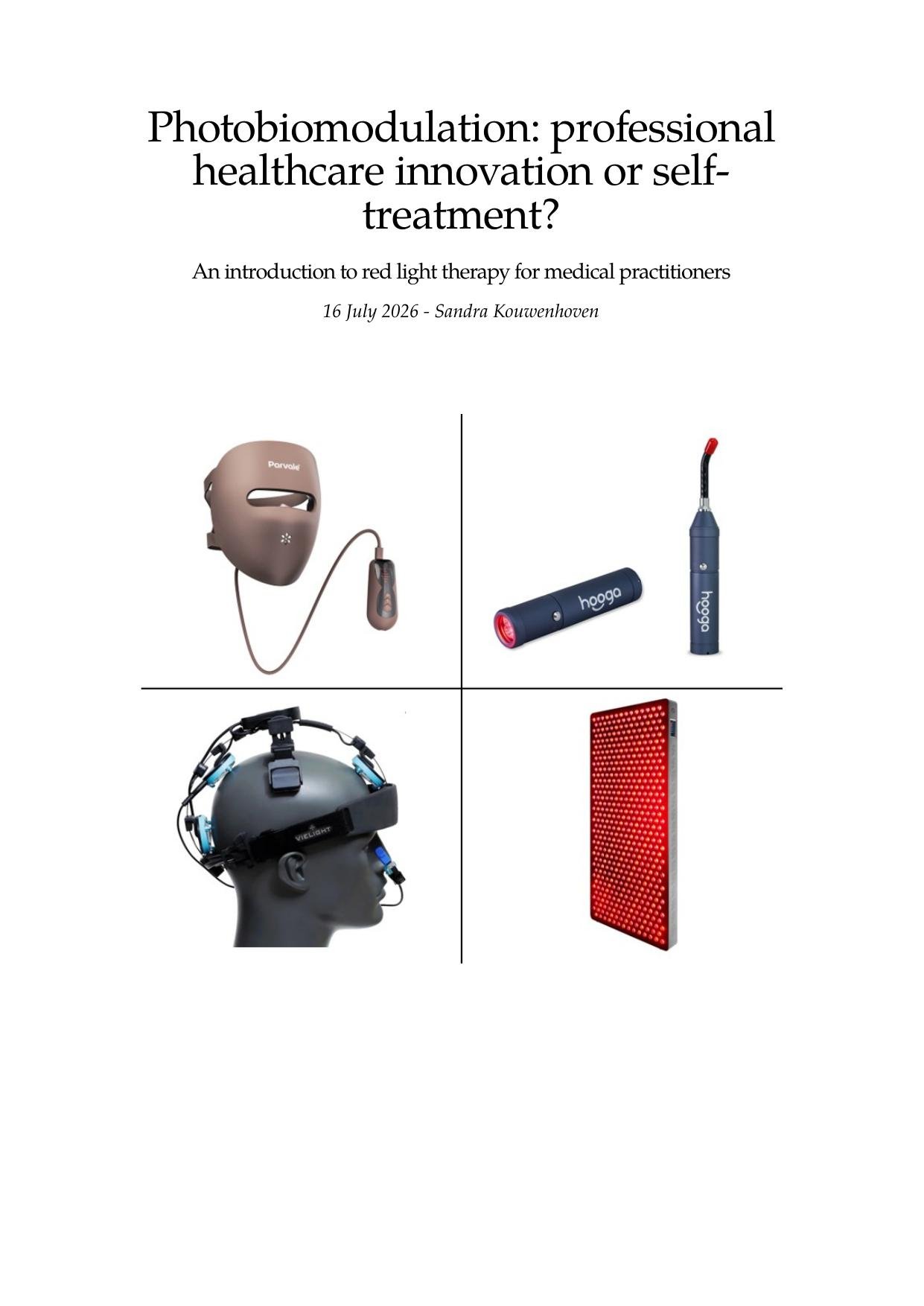
Er zijn inmiddels honderden van dit soort roodlichtapparaten op de consumentenmarkt, zoals:
- Kleine zaklampen met of zonder ’tip’ voor in neus, mond of oor
- Gezichtsmaskers
- ‘Handheld’ devices voor het behandelen van bv een gewricht
- Tandenborstels met rood licht in de kop
- Petten voor haargroei
- Matten of slaapzakken
- Kleine en grote ‘full body’ panelen
- Apparaten specifiek voor huisdieren
Als je bij online shops zoekt op ‘Rood licht therapie’ kom je de vreemdste producten tegen.
Deze apparaten beschikken vaak over meerdere golflengten: meestal één tot drie in het rode lichtspectrum en één tot drie in het nabij-infraroodspectrum. Sommige apparaten bevatten daarnaast ook blauw licht. De verschillende golflengten kunnen doorgaans afzonderlijk of gecombineerd worden gebruikt. Het door de fabrikant opgegeven vermogen is hierbij meestal de optelsom van de vermogens van de afzonderlijke golflengten.
Ook de eerdergenoemde apparaten voor de behandeling van de hersenen – waar medici niet zomaar mee mogen werken – zijn voor consumenten te koop. Zij kunnen hiermee dus zelf mee experimenteren. Al zijn deze dure apparaten hier niet per se voor nodig; met elk apparaat met de juiste golflengte(n) en voldoende vermogen, zoals veel handheld devices en panelen, kan het brein bereikt worden.
In de Verenigde Staten is zelfbehandeling meer ingebed in de cultuur, maar het ligt voor de hand dat het aantal mensen in Nederland dat zelf met PBM aan de slag gaat de komende jaren zal toenemen onder invloed van social media en influencers. In 2024 gaf cosmetisch arts David Mosmuller in het Algemeen Dagblad al aan dat hij dagelijks vragen kreeg van patiënten over de werking van PBM.41 De kans is groot dat dit soort vragen bij steeds meer specialismen gesteld gaan worden.
In hetzelfde artikel pleit dermatoloog Gertruud Krekels voor meer onderzoek naar de gunstige effecten van rood licht op de huid, met als doel beter inzicht te krijgen in optimale dosering, golflengten en lichtbronnen, zodat een echt effectieve behandeling in de thuissituatie mogelijk is. Dit zou kunnen leiden tot ‘PBM op doktersvoorschrift’.
Naast het ontbreken van duidelijke behandelprotocollen is er nog een ander knelpunt om thuisbehandeling met PBM te adviseren of voor te schrijven. Momenteel kunnen fabrikanten allerlei claims doen, terwijl consumenten niet kunnen controleren of de golflengte en het vermogen ook echt kloppen.
Een onderzoeksgroep uit het VK, onder leiding van dr. Mark Cronshaw, tandarts en expert in lasertherapie en PBM binnen de tandheelkunde, heeft onderzoek gedaan naar vijf led-zaklampen voor oraal gebruik.42 Deze apparaten kochten zij via webshops. Sommigen waren CE-gecertificeerd, maar enkel voor elektrische veiligheid, niet als medisch hulpmiddel.
De gebruikersfeedback was over het algemeen positief wat betreft subjectieve pijnverlichting en wondgenezing, maar de resultaten vertoonden grote verschillen in prestaties, inconsistenties in dosering en beperkte evidence-based instructies.
De onderzoekers concludeerden dat het thuisgebruik van led-PBM-apparaten potentieel interessant is, maar dat deze apparaten niet zomaar door professionals kunnen worden voorgeschreven aan hun patiënten. Standaardisatie, certificering en betere instructies zijn nodig om veilig en effectief gebruik te waarborgen.
14. Wellnessbehandelingen en alternatieve zorg
Zolang er geen medische claims worden gedaan, kunnen PBM-behandelingen in principe worden aangeboden door commerciële aanbieders, bijvoorbeeld wellnesscentra of sportscholen. De vraag is echter of dit wenselijk is, omdat de biologische effecten van PBM veel verder reiken dan bijvoorbeeld die van een infrarood sauna.
Wanneer iemand een apparaat voor eigen gebruik aanschaft, is hij zelf verantwoordelijk voor het gebruik ervan. Maar wie ziet erop toe dat zieke mensen niet worden behandeld met niet-gecertificeerde apparatuur door personen zonder medische opleiding? Online vond ik bijvoorbeeld een gezondheidscentrum voor alternatieve zorg dat zonder arts werkt met een krachtige PBM-helm (Bron: openbare informatie).
15. Kosten
Als wordt gekeken naar de kosten van apparatuur voor PBM, kan het een relatief goedkope interventie zijn. De apparaten die momenteel op de consumentenmarkt beschikbaar zijn, variëren in prijs van enkele tientallen tot enkele duizenden euro’s. Daarbij moet echter worden opgemerkt dat deze apparaten zijn ontwikkeld voor individueel gebruik en mogelijk aanpassingen vereisen – bijvoorbeeld ten aanzien van hygiëne – om in een klinische setting toegepast te kunnen worden. Daarnaast zal medische certificering naar verwachting leiden tot hogere kosten.
Tegelijkertijd bestaat de mogelijkheid dat PBM kan bijdragen aan kostenreductie in de gezondheidszorg. In een kleine studie (n=60; 30 PBM, 30 Sham) werd bijvoorbeeld gevonden dat PBM de verblijfsduur op de IC kan verkorten en de spierkracht en mobiliteit kan verbeteren.43 Ook kan PBM kostenbesparend zijn wanneer het wordt ingezet voor wondgenezing bij mensen met diabetes44, waarbij mogelijk amputaties voorkomen kunnen worden (naast de impact voor de patiënt). Daarnaast zijn er nog vele andere toepassingen denkbaar waarbij PBM mogelijk kostenbesparend kan werken.
16. Beschouwing
Het is algemeen bekend dat mensen zonlicht nodig hebben voor de aanmaak van vitamine D. Daarnaast weten veel mensen dat zonlicht effect heeft op het circadiaan ritme en dat een gebrek aan zonlicht kan bijdragen aan stemmingsklachten, zoals een winterdepressie. Veel minder bekend is echter dat licht ook op cellulair niveau een rol speelt en processen kan beïnvloeden die betrokken zijn bij de energieproductie.
In de moderne samenleving brengen veel mensen het grootste deel van hun tijd binnenshuis door, vaak onder kunstlicht, waardoor de blootstelling aan natuurlijk zonlicht beperkt is. Dit roept de vraag op of de afname van blootstelling aan natuurlijk licht mogelijk gezondheidseffecten heeft die nog onvoldoende worden begrepen.
Tegelijkertijd worden steeds meer aandoeningen – zoals de ziekte van Parkinson, Alzheimer en type 2-diabetes – in verband gebracht met niet-genetische mitochondriale disfunctie. Dit roept de vraag op of er een relatie bestaat tussen verminderde blootstelling aan natuurlijk licht en verstoringen in cellulaire energieprocessen. Een dergelijk verband hoeft niet causaal te zijn, maar zou mogelijk een cofactor kunnen zijn, naast andere omgevings- en leefstijlfactoren.
De ontdekking van Endre Mester in 1967 heeft geleid tot het ontstaan van een nieuw onderzoeksgebied, waar maandelijks meer publicaties over verschijnen. Desondanks wordt PBM in de medische praktijk nog beperkt toegepast, voornamelijk vanwege het ontbreken van grootschalige gerandomiseerde studies en daarmee sterk klinisch bewijs.
Ondertussen is er een florerende consumentenmarkt ontstaan, waarin steeds meer apparaten voor thuistoepassing beschikbaar komen. Deze worden gepromoot via sociale media, soms onderbouwd met recente publicaties en interviews met neurowetenschappers.
Omdat PBM ingrijpt op biologische processen in het lichaam, roept dit echter vragen op. Wanneer de techniek wordt gebruikt voor het tegengaan van huidveroudering of om sportprestaties te verbeteren, zal dat op weinig bezwaar stuiten. Maar wanneer men zelf aan de slag gaat om bijvoorbeeld neurologische aandoeningen zoals de ziekte van Parkinson of de gevolgen van hersentrauma te behandelen, begeeft men zich op medisch terrein.
Omdat uit studies tot nu toe blijkt dat PBM weinig bijwerkingen kent en deze van voorbijgaande aard zijn, lijken de risico’s beperkt. Tegelijkertijd zijn er andere aspecten die zorgen oproepen.
Als PBM zich als behandelvorm verder ontwikkelt en wordt toegepast buiten de reguliere zorgstructuren, verandert de rol van de arts als beoordelaar en begeleider van behandelingen. Ondertussen blijft medische betrokkenheid nodig voor monitoring en mogelijk het aanpassen van medicatie, bijvoorbeeld wanneer toepassing van PBM leidt tot een verminderde medicatiebehoefte bij diabetes type 2 of de ziekte van Parkinson.
Daarnaast spelen er ook ethische vragen. Wanneer iemand ervoor kiest om zichzelf met een consumentenproduct te behandelen, ligt de verantwoordelijkheid bij de persoon zelf. Een andere situatie ontstaat wanneer iemand PBM toepast bij een ander persoon, bijvoorbeeld bij een familielid met de ziekte van Parkinson. Daarmee grijpt die persoon in op de biologische processen in het lichaam van het familielid. Is dat vergelijkbaar met het voorzetten van een maaltijd, waarmee ook invloed uitgeoefend wordt op de celbiologie, of eerder met het toedienden van medicatie of radiotherapie? En hoe zit dit dan met ‘informed consent’? Ditzelfde geldt voor commerciële toepassing door personen zonder medische opleiding.
Uit gebruikersgroepen op social media blijkt dat het rode licht veel aantrekkingskracht heeft op huisdieren zoals honden en katten. Er zijn zelfs apparaten met aparte instellingen voor huisdieren. Naast de vraag of dit wenselijk en ethisch verantwoord is, roept dit de vraag op of de laagdrempelige beschikbaarheid van PBM de drempel verlaagt om bijvoorbeeld ook jonge kinderen aan rood of nabij-infrarood licht bloot te stellen. De perceptie dat PBM natuurlijk en onschadelijk is, kan hierbij een rol spelen. Ouders zouden kunnen hopen dat hun kind er baat bij heeft, bijvoorbeeld omdat uit kleine studies blijkt dat PBM een positief effect kan hebben op cognitieve functies. En wat als ouders hun kind met autisme, epilepsie of een andere ziekte of aandoening hier zelf mee gaan behandelen? Omdat er geen restricties zijn voor de toepassing van PBM, is er niets dat dit tegenhoudt.
Het gebrek aan grote studies brengt ook een risico met zich mee. Vaak komen bijwerkingen van medicatie pas aan het licht wanneer grote groepen mensen deze gaan gebruiken. Dit zou ook bij PBM het geval kunnen zijn. Daarnaast zijn de onderzoeken die zijn gedaan vaak maar van korte duur, waardoor er nog geen zicht op de effecten van PBM op lange termijn. Dit is relevant omdat er consumenten zijn die dagelijks of meerdere keren per week 20 minuten een paneel met relatief hoog vermogen gebruiken (bijvoorbeeld 90mW/cm2).
Vanuit het perspectief van de consument, of in dit geval beter gezegd de patiënt, kan het echter ook voordelen hebben om zelf over een (aanvullende) behandelmethode voor zijn of haar aandoening te kunnen beschikken. Dit kan bijdragen aan meer eigen regie over de gezondheid, waarbij de patiënt minder uitsluitend afhankelijk is van een zorgverlener. Een bijkomend voordeel van thuisgebruik is dat de apparatuur op ieder gewenst moment beschikbaar is, waardoor de patiënt de meest gunstige behandeltijd – bijvoorbeeld voor het slapen gaan – en frequentie kan bepalen. Ook kan indien gewenst de behandeling langdurig voortgezet worden.
Daar staat tegenover dat zelftoepassing van PBM niet voor iedere patiënt vanzelfsprekend geschikt is. Het vereist voldoende kennis over de werking, dosering, behandelduur en mogelijke beperkingen van de methode. Ook bestaan er nog geen eenduidige, wetenschappelijke behandelprotocollen die de patiënt houvast kunnen bieden. Hierdoor bestaat het risico dat patiënten PBM onjuist toepassen of verwachtingen ontwikkelen die niet overeenkomen met de huidige wetenschappelijke inzichten.
17. Conclusies en aanbevelingen
De vraag of photobiomodulation vooral moet worden gezien als professionele zorginnovatie of als vorm van zelfbehandeling kent geen eenvoudig antwoord. Door de voorsprong van producten op de consumentenmarkt is zelfbehandeling bij medische aandoeningen moeilijk te voorkomen, waardoor artsen in de praktijk mensen tegen kunnen komen die PBM op zichzelf toepassen. Om hierbij aan te kunnen sluiten is op zijn minst kennis van de techniek en de bekende biologische effecten nodig.
Omdat PBM aangetoonde biologische effecten heeft en uit onderzoeken blijkt dat het ook klinische effecten heeft, verdient het ook aandacht als mogelijke professionele zorginnovatie, al verschilt de mate van bewijs per toepassing.
Om eventuele toepassing in de professionele zorgsetting of PBM op voorschrift mogelijk te maken is gecoördineerd onderzoek nodig. Per medisch specialisme of per aandoening zouden op basis van bestaand onderzoek RCT’s moeten plaatsvinden, waarbij afspraken worden gemaakt over vaste parameters (bijvoorbeeld de apparatuur, golflengte en afstand tot het apparaat) en met welke parameters gevarieerd zal worden (behandeltijd, behandelfrequentie of aantal behandelingen). Dit om te voorkomen dat onderzoeken niet vergelijkbaar zijn doordat er te veel parameters variëren. Deze parameters dienen in publicaties duidelijk vermeld te worden.
Ook zou onderzoek moeten worden gedaan naar mogelijke bijwerkingen en langetermijneffecten, zodat kan worden vastgesteld of veiligheidsrichtlijnen of gebruiksrestricties nodig zijn, zoals een minimumleeftijd, een maximale behandelduur of een maximale behandelfrequentie, zowel voor medisch als voor thuisgebruik.
Daarnaast is onafhankelijke certificering van apparatuur nodig, ook voor consumentenproducten. Hierdoor kunnen consumenten en zorgverleners erop vertrouwen dat de technische specificaties, zoals golflengte en vermogen, overeenkomen met wat de fabrikant vermeldt.
Omdat zelfbehandeling mogelijk invloed kan hebben op reguliere medische behandelingen zouden consumentenproducten voorzien moeten zijn van de aanbeveling om bij een medische aandoening altijd overleg te plegen met hun arts of andere zorgverlener.
18. Over de auteur
Sandra Kouwenhoven heeft een verpleegkundige achtergrond en is langdurig arbeidsongeschikt. Tijdens haar zoektocht naar verlichting van haar gezondheidsklachten kwam zij in aanraking met PBM. Tijdens haar verdieping in dit onderwerp viel het haar op dat er een duidelijke discrepantie bestaat tussen de snelgroeiende beschikbaarheid van PBM-apparatuur op de consumentenmarkt en de beperkte toepassing en bekendheid ervan binnen de reguliere medische praktijk.
Met deze publicatie wil zij bijdragen aan meer bekendheid over PBM onder medici en aandacht vragen voor de noodzaak van zorgvuldig, gecoördineerd en gestandaardiseerd onderzoek. Het doel hiervan is om de wetenschappelijke onderbouwing te versterken, zodat beter beoordeeld kan worden welke toepassingen van PBM daadwerkelijk een plaats kunnen krijgen binnen de gezondheidszorg en welke toepassingen verantwoord en zinvol zijn als zelfbehandeling.
The author declares no commercial or financial interests that could influence the content of this article, and no specific grant or funding was received for this article.
19. Disclaimer
Dit document is uitsluitend bedoeld er informatie en vormt geen medisch advies. Heb je een medische aandoening en overweeg je PBM te gebruiken, bespreek dit dan eerst met een arts, ook als je PBM voor een andere klacht of toepassing wilt gebruiken.
20. Bronnen
[1] Anders, J. J., Lanzafame, R. J., & Arany, P. R. (2015). Low-level light/laser therapy versus photobiomodulation therapy. Photomedicine and laser surgery, 33(4), 183–184. https://doi.org/10.1089/pho.2015.9848
[2] Abijo A, Lee CY, Huang CY, Ho PC, Tsai KJ. The Beneficial Role of Photobiomodulation in Neurodegenerative Diseases. Biomedicines. 2023 Jun 26;11(7):1828. doi: 10.3390/biomedicines11071828. PMID: 37509468; PMCID: PMC10377111.
[3] Mester E, Szende B, Gärtner P. Die Wirkung der Lasstrahlen auf den Haarwuchs der Maus. Radiobiol Radiother. 1968;9(5):621–626.
[4] Whitten, A (2018). The Ultimate Guide To Red Light Therapy. Archangel Ink
[5] Wang L, Mao L, Huang Z, Switzer JA, Hess DC, Zhang Q. Photobiomodulation: shining a light on depression. Theranostics 2025; 15(2):362-383. doi:10.7150/thno.104502. https://www.thno.org/v15p0362.htm
[6] Graeme Ewan Glass, Photobiomodulation: The Clinical Applications of Low-Level Light Therapy, Aesthetic Surgery Journal, Volume 41, Issue 6, June 2021, Pages 723–738, https://doi.org/10.1093/asj/sjab025
[7] Ferraresi, C., Huang, Y. Y., & Hamblin, M. R. (2016). Photobiomodulation in human muscle tissue: an advantage in sports performance? Journal of biophotonics, 9(11-12), 1273–1299. https://doi.org/10.1002/jbio.201600176
[8] Photobiomodulation (PBM) research – a comprehensive database [Spreadsheet]. (z.d.). Google Sheets. Geraadpleegd op 12 februari 2026, van http://www.bitly.com/PBM-database
[9] Equi‑Tech. (z.d.). Infrarood Hoef Pad [Productpagina]. Equi‑Tech. https://equi-tech.nl/collections/rood-licht-therapie-voor-paarden/products/infrarood-hoef-pad
[10] Coelho RC, Zerbinati LP, de Oliveira MG, Weber JB. Systemic effects of LLLT on bone repair around PLLA-PGA screws in the rabbit tibia. Lasers Med Sci. 2014 Mar;29(2):703-8. doi: 10.1007/s10103-013-1384-4. Epub 2013 Jul 6. PMID: 23832178.
[11] Gordon, Luke C.; Johnstone, Daniel M. PhD,*. Remote photobiomodulation: an emerging strategy for neuroprotection. Neural Regeneration Research 14(12):p 2086-2087, December 2019. | DOI: 10.4103/1673-5374.262573
[12] Powner MB, Jeffery G. Light stimulation of mitochondria reduces blood glucose levels. J Biophotonics. 2024 May;17(5):e202300521. doi: 10.1002/jbio.202300521. Epub 2024 Feb 20. PMID: 38378043.
[13] Gabel, C. P., Petrie, S. R., Mischoulon, D., Hamblin, M. R., Yeung, A., Sangermano, L., & Cassano, P. (2018). A case control series for the effect of photobiomodulation in patients with low back pain and concurrent depression. Laser therapy, 27(3), 167–173. https://doi.org/10.5978/islsm.27_18-OR-18
[14] Ji, Q., Yan, S., Ding, J., Zeng, X., Liu, Z., Zhou, T., Wu, Z., Wei, W., Li, H., Liu, S., & Ai, S. (2024). Photobiomodulation improves depression symptoms: a systematic review and meta-analysis of randomized controlled trials. Frontiers in psychiatry, 14, 1267415. https://doi.org/10.3389/fpsyt.2023.1267415
[15] Brassolatti, P., Parizotto, N. A., Guirro, E. C. O., de Almeida, L. A., Tim, C. R., Nishioka, M. A., de Souza, J. R., & de Andrade, A. L. M. (2025). Systemic photobiomodulation: an integrative review of evidence for intravascular laser irradiation of blood and vascular photobiomodulation. Lasers in medical science, 40(1), 35. https://doi.org/10.1007/s10103-024-04233-6
[16] N. F. Guimarães, G., dos Santos Cardoso, F., Gamboa, L., W. Barrett, D., & Gonzalez-Lima, F. (2025). Abdominal Photobiomodulation and the Gut-Brain Axis: A Systematic Review of Mechanistic and Translational Evidence. Biomedicines, 13(12), 3042. https://doi.org/10.3390/biomedicines13123042
[17] Bicknell, B., Liebert, A., McLachlan, C. S., & Kiat, H. (2022). Microbiome Changes in Humans with Parkinson’s Disease after Photobiomodulation Therapy: A Retrospective Study. Journal of Personalized Medicine, 12(1), 49. https://doi.org/10.3390/jpm12010049
[18] Liebert, A., Bicknell, B., Laakso, E. L., Heller, G., Jalilitabaei, P., Tilley, S., Mitrofanis, J., & Kiat, H. (2021). Improvements in clinical signs of Parkinson’s disease using photobiomodulation: a prospective proof-of-concept study. BMC neurology, 21(1), 256. https://doi.org/10.1186/s12883-021-02248-y
[19] Heiskanen, V., & Hamblin, M. R. (2018). Photobiomodulation: lasers vs. light emitting diodes?. Photochemical & photobiological sciences : Official journal of the European Photochemistry Association and the European Society for Photobiology, 17(8), 1003–1017. https://doi.org/10.1039/c8pp90049c
[20] Chaves, M. E., Araújo, A. R., Piancastelli, A. C., & Pinotti, M. (2014). Effects of low-power light therapy on wound healing: LASER x LED. Anais brasileiros de dermatologia, 89(4), 616–623. https://doi.org/10.1590/abd1806-4841.20142519
[21] Chung, H., Dai, T., Sharma, S. K., Huang, Y. Y., Carroll, J. D., & Hamblin, M. R. (2012). The nuts and bolts of low-level laser (light) therapy. Annals of biomedical engineering, 40(2), 516–533. https://doi.org/10.1007/s10439-011-0454-7
[22] Bonnans, M., Fouque, L., Pelletier, M., Chabert, R., Pinacolo, S., Restellini, L., & Cucumel, K. (2020). Blue light: Friend or foe?. Journal of photochemistry and photobiology. B, Biology, 212, 112026. https://doi.org/10.1016/j.jphotobiol.2020.112026
[23] Vatansever, F., & Hamblin, M. R. (2012). Far infrared radiation (FIR): its biological effects and medical applications. Photonics & lasers in medicine, 4, 255–266. https://doi.org/10.1515/plm-2012-0034
[24] Ash, C., Dubec, M., Donne, K., & Bashford, T. (2017). Effect of wavelength and beam width on penetration in light-tissue interaction using computational methods. Lasers in medical science, 32(8), fig 1, 1909–1918. https://doi.org/10.1007/s10103-017-2317-4
[25] Nairuz, T., Sangwoo-Cho, & Lee, J. H. (2024). Photobiomodulation Therapy on Brain: Pioneering an Innovative Approach to Revolutionize Cognitive Dynamics. Cells, 13(11), 966. https://doi.org/10.3390/cells13110966
[26] Hashmi, J. T., Huang, Y. Y., Sharma, S. K., Kurup, D. B., De Taboada, L., Carroll, J. D., & Hamblin, M. R. (2010). Effect of pulsing in low-level light therapy. Lasers in surgery and medicine, 42(6), 450–466. https://doi.org/10.1002/lsm.20950
[27] de Freitas, L. F., & Hamblin, M. R. (B2016). Proposed Mechanisms of Photobiomodulation or Low-Level Light Therapy. IEEE journal of selected topics in quantum electronics: a publication of the IEEE Lasers and Electro-optics Society, 22(3), 7000417. https://doi.org/10.1109/JSTQE.2016.2561201
[28] Cronshaw, M., Parker, S., Hamadah, O., Arnabat-Dominguez, J., & Grootveld, M. (2025). Photobiomodulation LED Devices for Home Use: Design, Function and Potential: A Pilot Study. Dentistry journal, 13(2), 76. https://doi.org/10.3390/dj13020076
[29] Huang Y-Y, Sharma SK, Carroll J, Hamblin MR. Biphasic Dose Response in Low Level Light Therapy – an Update. Dose-Response. 2011;9(4). doi:10.2203/dose-response.11-009.
[30] MITO LIGHT. (z.d.). Frequently Asked Questions [Webpagina]. MITO LIGHT. https://www.mitolight.com/frequently-asked-questions/
[31] BlockBlueLight. (z.d.). Frequently Asked Questions [Webpagina]. BlockBlueLight. https://www.blockbluelight.co.uk/pages/frequently-asked-questions/
[32] Glass G. E. (2023). Photobiomodulation: A Systematic Review of the Oncologic Safety of Low-Level Light Therapy for Aesthetic Skin Rejuvenation. Aesthetic surgery journal, 43(5), NP357–NP371. https://doi.org/10.1093/asj/sjad018
[33] Hernández-Bule, M. L., Naharro-Rodríguez, J., Bacci, S., & Fernández-Guarino, M. (2024). Unlocking the Power of Light on the Skin: A Comprehensive Review on Photobiomodulation. International journal of molecular sciences, 25(8), 4483. https://doi.org/10.3390/ijms25084483
[34] de Pauli Paglioni, M., Araújo, A. L. D., Arboleda, L. P. A., Palmier, N. R., Fonsêca, J. M., Gomes-Silva, W., Madrid-Troconis, C. C., Silveira, F. M., Martins, M. D., Faria, K. M., Ribeiro, A. C. P., Brandão, T. B., Lopes, M. A., Leme, A. F. P., Migliorati, C. A., & Santos-Silva, A. R. (2019). Tumor safety and side effects of photobiomodulation therapy used for prevention and management of cancer treatment toxicities. A systematic review. Oral oncology, 93, 21–28. https://doi.org/10.1016/j.oraloncology.2019.04.004
[35] Al Balah, O. F., Rafie, M., & Osama, A. R. (2025). Immunomodulatory effects of photobiomodulation: a comprehensive review. Lasers in medical science, 40(1), 187. https://doi.org/10.1007/s10103-025-04417-8
[36] Tan, Natania Rae XiangQina, Chan, Kai Ena, Lim, Blanche Xiao Honga,b; Giannaccare, Giuseppec; Najjar, Raymond P.b,d,e,f; Lim, Chris Hong Longb,f,g,h. Photobiomodulation: evidence and applications in ophthalmology. Current Opinion in Ophthalmology 36(5):p 345-381, September 2025. | DOI: 10.1097/ICU.0000000000001154
[37] Tunér, J., & Jenkins, P. A. (2016). Parameter Reproducibility in Photobiomodulation. Photomedicine and laser surgery, 34(3), 91–92. https://doi.org/10.1089/pho.2016.4105
[38] Castaño-Castaño, S., Zorzo, C., Martínez-Esteban, J. Á., & Arias, J. L. (2024). Dosimetry in cranial photobiomodulation therapy: effect of cranial thickness and bone density. Lasers in medical science, 39(1), 76. https://doi.org/10.1007/s10103-024-04024-z
[39] McGee, C., Liebert, A., Bicknell, B., Pang, V., Isaac, V., McLachlan, C. S., Kiat, H., & Herkes, G. (2023). A Randomized Placebo-Controlled Study of a Transcranial Photobiomodulation Helmet in Parkinson’s Disease: Post-Hoc Analysis of Motor Outcomes. Journal of Clinical Medicine, 12(8), 2846. https://doi.org/10.3390/jcm12082846
[40] Flora, J., & Watson Huffer, K. (2024). Transcranial Photobiomodulation Therapy as an Intervention for Opioid Cravings and Depression: A Pilot Cohort Study. Photobiomodulation, photomedicine, and laser surgery, 42(8), 509–513. https://doi.org/10.1089/photob.2024.0032
[41] Van Wees, C. (2024, 10 augustus). Therapie met rood licht wordt door TikTokkers geprezen: dit zeggen artsen over de werking. Algemeen Dagblad. https://www.ad.nl/gezond/therapie-met-rood-licht-wordt-door-tiktokkers-geprezen-dit-zeggen-artsen-over-de-werking~a0c76ff1/
[42] Cronshaw, M., Parker, S., Hamadah, O., Arnabat-Dominguez, J., & Grootveld, M. (2025). Photobiomodulation LED Devices for Home Use: Design, Function and Potential: A Pilot Study. Dentistry journal, 13(2), 76. https://doi.org/10.3390/dj13020076
[43] Neto, R. P. M., Espósito, L. M. B., da Rocha, F. C., Filho, A. A. S., Silva, J. H. G., de Sousa Santos, E. C., Sousa, B. L. S. C., Dos Santos Gonçalves, K. R. R., Garcia-Araujo, A. S., Hamblin, M. R., & Ferraresi, C. (2024). Photobiomodulation therapy (red/NIR LEDs) reduced the length of stay in intensive care unit and improved muscle function: A randomized, triple-blind, and sham-controlled trial. Journal of biophotonics, 17(5), e202300501. https://doi.org/10.1002/jbio.202300501
[44] Oyebode, O., Houreld, N. N., & Abrahamse, H. (2021). Photobiomodulation in diabetic wound healing: A review of red and near-infrared wavelength applications. Cell biochemistry and function, 39(5), 596–612. https://doi.org/10.1002/cbf.3629
[45] Jonathan Jarry, Office for Science and Society (McGill University). Hype around photobiomodulation. https://www.mcgill.ca/oss/article
Colofon
© Sandra Kouwenhoven, 2026
Gebruik toegestaan voor niet-commerciële doeleinden met bronvermelding
Contact: info@pbmvoormedici.nl
Dit document betreft een beschouwende analyse op basis van beschikbare literatuur en is geen systematische review.
Dit document is uitsluitend bedoeld er informatie en vormt geen medisch advies. Heb je een medische aandoening en overweeg je PBM te gebruiken, bespreek dit dan eerst met een arts, ook als je PBM voor een andere klacht of toepassing wilt gebruiken.
Foto 1 beschikbaar gesteld door Parvale
Foto 2 beschikbaar gesteld door Hooga – Image courtesy of Hooga
Foto 3 beschikbaar gesteld door Vielight Inc. – Image courtesy of Vielight Inc.
Foto 4 beschikbaar gesteld door Mito light – Image courtesy of Mito Light
Vermelding van merknamen dient uitsluitend ter illustratie van bestaande commerciële toepassingen en impliceert geen aanbeveling of samenwerking.