Photobiomodulation: professional healthcare innovation or self-treatment?
An introduction in red light therapy for medical practicioners
Is photobiomodulation (PBM) a professional healthcare innovation or self-treatment?
While searching for relief from my own health complaints in 2025, I came across red light therapy, which is usually referred to as “photobiomodulation” (PBM) in research. This is atherapy that uses red and near-infrared light to influence biological processes in the body.
I found it a fascinating technique and read with surprise about the many possible applications and the freely available equipment. How was it possible that I had never heard of this before?
Because I don’t just believe things blindly and didn’t want to waste money, I started looking into how it works and the scientific research behind it. My nursing background has taught me to look critically at health claims, and that critical lens helped me separate fact from fiction. It turned out that a great deal of research has already been done, but large RCTs are still lacking, and for many conditions there remains a lot of uncertainty about its true value as a treatment method.
During a consultation with a neurologist, I asked him whether he was familiar with it, since I wanted to explore whether it might help with my own condition. Unfortunately, he had no knowledge of it. This made me acutely aware of the gap between the knowledge I had gathered as a layperson about this treatment method and what was known in professional care.
As the neurologist was interested, we agreed that I would send him some information. But what should I choose from the many websites, YouTube videos, and scientific publications out there? How could I effectively convey my basic knowledge of the treatment technique to a doctor who already has so much information to process? On top of that, more healthcare providers around me turned out to be interested, so it seemed better to take a broader approach.
I decided to write a clear and well-organized piece myself, covering the basic principles, possible applications, and the current state of research. Because I wanted my information to be well substantiated, I also decided to add literature references. And before I knew it, it had naturally turned into a kind of white paper or position paper, although there isn’t really a name for a paper written by someone without a job title or professional position in the field.
I hope this document provides a solid foundation for medical professionals and inspires further exploration of PBM within their own field. I also hope that coordinated research into PBM will emerge in the Netherlands, so that there is more clarity on whether PBM is applicable within medical care, or whether it will remain primarily something for the consumer market.
Read paper:
Summary
Photobiomodulation (PBM) is a form of therapy in which red and near-infrared light is used to influence biological processes in the body. Although a great deal of research has already been done on it, its application in regular healthcare is still very limited.
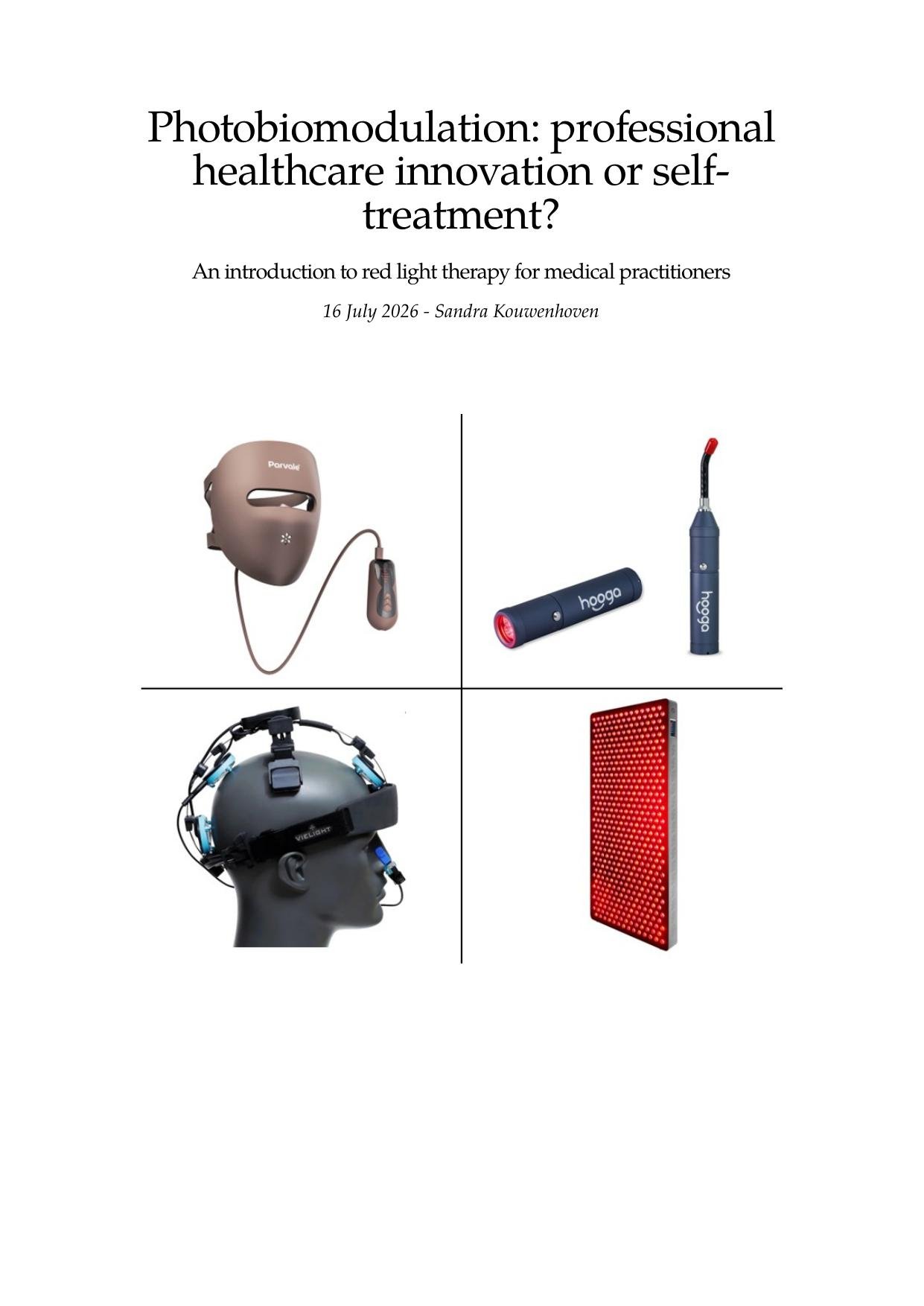
Meanwhile, more and more devices are becoming available on the consumer market for home use. As a result, consumers now have access to a treatment method that is often still unfamiliar to physicians and that physicians cannot simply apply. This raises questions about the role of practitioners, possible risks, and ethical issues.
The aim of this paper is to introduce physicians to PBM and to examine whether PBM should be seen as a professional healthcare innovation or as a form of self-treatment. To this end, attention is paid to, among other things, the technique, its possible applications, side effects, contraindications, and research.
PBM influences cellular processes, including mitochondrial energy production. There are indications of clinical effects for various conditions, but the quality and quantity of evidence differ greatly per application. Despite the large body of research (more than 7000 studies), the large-scale studies and standardized protocols needed for application in medical practice are still lacking.
Given the many positive studies, PBM deserves serious scientific attention. For PBM to be applied in medical practice, there is a particular need for coordinated research by specialty and condition, with agreed research methods and standardized reporting of treatment parameters. In addition, research is needed to determine whether safety guidelines or usage restrictions are necessary.
At the same time, self-application is expected to increase further, making it desirable for medical practitioners to have basic knowledge of the treatment method, as well as its possible applications and limitations within their field.
In addition, independent certification of equipment is needed, for both medical and consumer products.